The Murder of the Mermaid

Are you ready to play?

Write your team name and e-mail here

The Little Mermaid is undoubtedly one of Copenhagen's most iconic statues.

She was exhibited for the first time in 1913, but only became world famous 50 years later in 1964 — when she was beheaded.

News of the Mermaid's murder went around the world. A true media circus arose when investigations failed to produce a culprit. And more importantly: the head was never found.

Over the years, many have tried to take credit for this famous act of vandalism, but the truth of what happened on the night of April 25, 1964, remains a mystery.

Your task is to find the culprit in this true and unsolved case.

You will follow in the footsteps of the police and journalists, examine the collected evidence, and solve puzzles.

POINT SYSTEM:
You collect points during the game.
You get +1000 points for each puzzle you find the answer to.
-100 points for each wrong answer.
-200 points for every HINT you use.
No points if you choose to get the whole answer.

Please remember: You must enter the answer yourself, also when you select "Get answer" - then click "Check answer".

(HINTs can make the game more fun and help along the way)

NOTE: Important that Game Master does not update/close their browser, as the game will start over.

Are you ready to get started?

Let's go back to the morning of April 25th, 1964…


It was a worker taking a Saturday morning walk along Langelinie, who first discovered that The Little Mermaid had lost her head.

He searched the water but found no trace of the sawed-off head. After this, he alerted the police.

The beheading of the mermaid was treated as a real murder, and the investigation was led by the head of the homicide department, Detective Inspector Hornslet.

The police's technical experts examined the sculpture for clues and found a large number of fingerprints - so many, in fact, that they could not use them to determine the perpetrator.

But you  have knowledge that the police did not have in 1964: Many have tried to take credit for the murder over the years.

Perhaps the prints can be used to judge who was actually present that night?

Below you will find numbered fingerprints, as well as photos of the area on the statue where the prints were found.

However, it is immediately clear that not all of this evidence is relevant.


Which fingerprints are NOT from The Little Mermaid?

Write the numbers in ascending order below.
(Use numbers only; no spaces or commas)

A Hint costs 200 points.

Do you need a Hint?

Use the method of exclusion. Look at the pictures and compare them with The Little Mermaid in front of you.

A major search was launched and the area close to the little mermaid was combed thoroughly by the police.
They found, among other things, a rusty saw blade in a bush.

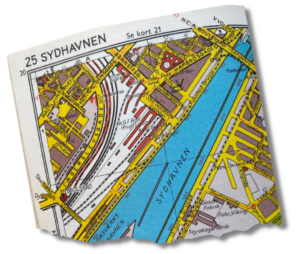
Your task is to follow in their footsteps to find the place where the saw blade was discovered in 1964.


To this end, you have found an old note that mentions the blade, as well as a map from 1964. Unfortunately, someone has spilled coffee on the note, so the last four digits are no longer legible...

These missing four digits are the key to figuring out exactly where the blade was found. Write them below.

A Hint costs 200 points.

Do you need a Hint?

Have you looked within the enlarged area on the map? (Green areas)

When it seemed that the case would remain unsolved, the artist Jørgen Nash announced he was the one who had sawed off the mermaid's head.

Here, Jørgen Nash (TV) is questioned by the head of the homicide department, Detective Inspector Hornslet.


Our first suspect:

JØRGEN NASH

The confession earned Jørgen Nash massive media coverage — both in Denmark and abroad — but when he was questioned by the police, he suddenly changed his explanation.

He now claimed a Norwegian shipping man had contacted him and confessed to the crime, stating that the head had been thrown into Utterslev Bog.

A major search with divers was launched, but no head was found in the muddy waters of the bog.

The story could therefore not be confirmed.

The media was fascinated, and Bertel Thomsen – a journalist for the newspaper B.T. –  took part in the hunt for the Mermaid's killer.

He received an anonymous tip: Jørgen Nash had hidden the sawn-off head inside a larger head of clay.

Bertel obtained this head but was ordered not to destroy it. He therefore chose to have it x-rayed.

A doctor at Horsens Municipal Hospital was on board with the idea and registered the head as a private patient.
B.T. paid DKK 150 for the treatment.

Bertel Thomson examined 6 different clay heads that weighed 1, 2, 3, 4, 5 and 6 kg, but only brought the head that weighed 2 kg to the hospital.

Total weights are written outside the rows and columns above.
Which head did Bertel Thomson choose to have X-rayed? A, B, C, D or F? 

A Hint costs 200 points.

Do you need a Hint?

Find the pyramid to find numbers for X and Y.

In the following years, Jørgen Nash avoided commenting on the case.

But in 1997, he published a memoir titled "The mermaid killer crosses his tracks ".

As PR for the book, he promised to reveal the name of the Norwegian man who would allegedly be present when the book was presented.

But when the day came, he changed his explanation once again.

In the book, he does not mention the Norwegian once, but took responsibility for the beheading himself. Stating that he threw the sawed-off head into Utterslev Mose.


Here is a quote from the book:

“[...] Wearing long fishing boots hooked to my waist belt, I sailed from the Burmeister and Wain side of the harbour outlet and headed for Langelinie, where the Little Mermaid sat enthroned on her Stone Age jetty.”


But there is more to this confession, a sentence that can be absolutely decisive in the search for the truth.

Unfortunately, it appears there are typographical errors in the print of the book you have obtained. There's a code breaker to help you decipher it, but it's not quite complete...

You solve the code and find the answer using the poem on the brown paper and the code breaker.


The whole sentence useful contains knowledge for the case.

Write the last word of the sentence as your answer below.

A Hint costs 200 points.

Do you need a Hint?

The poem tells you where to look for the keyword to fill in the missing 11 letters.

Jørgen Nash is not the only artist who has tried to take credit for the famous murder.

In 1991, the artist, Charles Mac Streton, reported that he had beheaded the mermaid.

In an interview he said:

"I was the one with the hacksaw. It was a hell of a job. We started at midnight. We thought it could be done in a couple of hours. But the saw was too weak. And we miscalculated. After four or five hours it started to get bright. We had to pack up and leave the mermaid with her throat half cut."

According to Mac Streton, no one noticed the saw marks on the mermaid's neck, so they returned the following night to finish the job.

He concludes by explaining that it suited them just fine that Jørgen Nash attracted the attention of the the press and the police, because the media coverage was overwhelming.


Charles Mac Streton was a controversial artist with several scandals to his name. Is he a more likely perpetrator than Jørgen Nash, or does he just want his name attached to an iconic work of art?

You are now standing in front of another iconic work of art, the Gefion Fountain.

Solve the puzzle and write the answer below to move on (no spaces, only letters).

A Hint costs 200 points.

Do you need a Hint?

The poem tells where you must stand to find the solution.

As time passed without any arrests, the story was kept alive via the morning papers.

BT and Ekstra Bladet in particular received anonymous letters and published interviews with people who wanted to take credit for the deed.

In fact, it was BT who released the first images of the vandalism on the very Saturday morning that the murder was discovered... The images were taken a few minutes before the printing deadline.

Were they just lucky to be in the right place at the right time?


Time tells a different story. When the mermaid lost her head again in 1998, there was also a press photographer who was "lucky" to take pictures shortly after the deed.

He's earned more than 100,000 DKK from this image material.

As the case became obsolete over time, he admitted in an interview that he had carried out the vandalism himself.

Could it have been a similar situation in 1964?

You are now standing at Amaliehaven, with a view to the Opera over the water on one side, and Amalienborg and the Marble Church on the other.


To proceed, you need four numbers.
Just like the press photographer, it requires you to stand in exactly the right place.

Write the 4 numbers below.

A Hint costs 200 points.

Do you need a Hint?

You have to move to get to the right place.

X marks the spot...

The ultimate piece of evidence – the Mermaid's head – is nowhere to be found, but we can take a closer look at the severed neck.

The hacksaw blade, which the police found near the crime scene, was rusty. But there was no rust in the saw marks on the mermaid. Instead, blue paint was found, indicating the use of a high-speed hacksaw.

A bronze caster examined the neck, and explained that the marks were created by a rough blade that was used like a jigsaw.

This means that the perpetrator must have sawed all the way around the neck's 34 cm circumference - however, there are signs that the last 2 cm were broken off.


It also turns out that Mac Streton's claim that the head was cut over the span of two nights is correct.

Two boys actually discovered the saw track in the Mermaid's neck on Friday afternoon. They told the police, who did not take them seriously at the time. It later emerged that 8 cm of the neck's circumference was sawn off on that first night.

Based on the thickness of the bronze and the conditions the perpetrator had to saw in, we can assume that they could saw an average of 2 cm in 15 minutes.


How much time did they spend sawing on the second night before the mermaid lost her head?

Write the time below in minutes
(Type only numbers, no spaces, periods or commas)

A Hint costs 200 points.

Do you need a Hint?

The text contains all the necessary information,
Remember: You have to find the time they SAWED during the second night.

You are now standing at the end of Nyhavn, with a view of Christianshavn on the other side of the water.

There is a reason you were sent here, because the last suspect is said to have thrown his head into the water not far from where you are now.

Perhaps it is still buried somewhere on the bottom.

In 2019, the media once again tried to solve the mermaid murder. This time it was Reimer Bo Christensen who made a documentary. In this documentary he is certain that it was his childhood friend, Henrik Bruun, who cut off the head of The Little Mermaid in 1964.

According to Reimer Bo, it as Henrik Bruun himself who told him the "secret", and during the course of the documentary he searched for evidence to prove it.

It turns out that Reimer Bo is not the only who believes that Henrik Bruun (and his friend Gunnar) were the ones who committed the crime in 1964.

Here is collected some of the evidence that it was Henrik Bruun who, together with his friend Gunnar, is responsible for the beheading.

The newspaper Information writes:

On April 25, 1964, The Little Mermaid lost her head, and according to psychologist and former youth rebel Finn Ejnar Madsen, the recently deceased painter Henrik Bruun was behind it

"In the 80s, Henrik told me that he had done it with a friend," says Finn Ejnar Madsen.


There is only one direct quote from Henrik Bruun himself on the topic. It was given to historian Annemette Sørensen, who wrote a thesis on tourist attractions in Denmark in is in 1987.

Here is an excerpt from the interview:

Interviewer: Can you briefly explain what actually happened on "the dark night" between the 23rd and 24th of April 1964.
Henrik: 64? Wasn't it in 62?
Interviewer: No, 64.
Henrik: I remember it was a bank holiday. And it WAS really dark. We — there were two of us — had also been down there the night before. It was hard work, with the a hacksaw, so we had to do it in two rounds.
Interviewer: The head.. did you take it with you?
Henrik: Yes. But later we threw it into the water.


To find out where Henrik Bruun allegedly threw the head into the water, you must solve this code...

Write the first word below to get points, but solve the whole code if you want to know the specific location.

A Hint costs 200 points.

Do you need a Hint?

To solve the Morse code look for help in the evidence folder.

Vote on who you would to find guilty with the knowledge we have today.

Write the letter of the person you find guilty.